Case Study 06 / 06 · Condé Nast Entertainment · 2018–2019
Backstage — Video
Production CMS
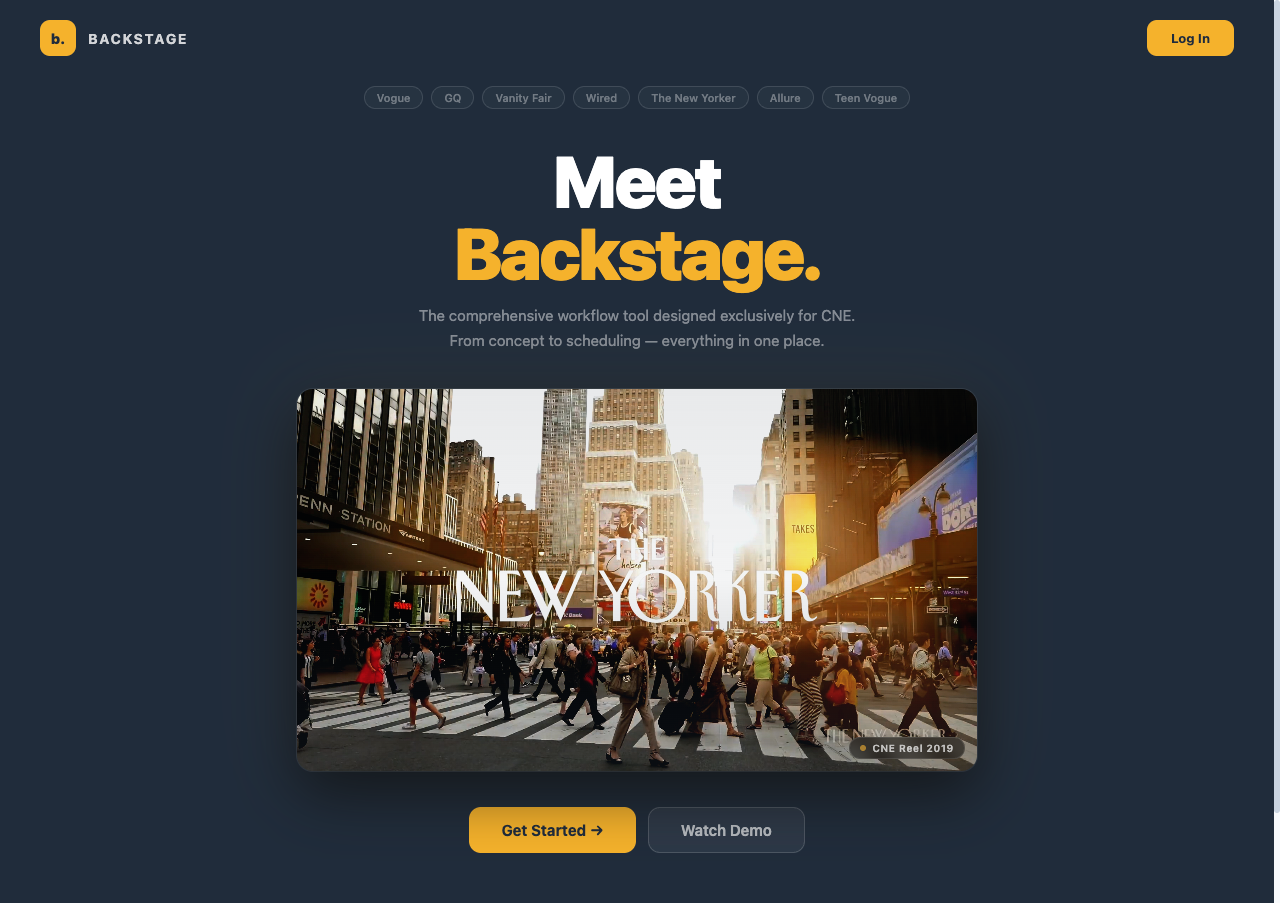
Condé Nast Entertainment produces hundreds of videos per year across Vogue, GQ, Vanity Fair, Wired, and The New Yorker. The teams behind those videos were operating across disconnected spreadsheets, email chains, and legacy tools with no single source of truth. I led the end-to-end UX design of Backstage: a purpose-built production platform that replaced all of it.
My Role
Lead Product Designer: end-to-end UX, user research, information architecture, interaction design, visual design
Team
Product Design, Engineering, Product Management, Operations
Platform
Web: Internal Tool
Scope
Full platform: projects, agreements, scheduling, activity feed, onboarding, and admin
Hundreds of videos per year. Four-plus disconnected tools to manage them.
Condé Nast Entertainment runs a high-volume production operation: hundreds of videos per year across flagship brands including Vogue, GQ, Vanity Fair, Wired, and The New Yorker. Behind every video is a complex pipeline: concept development, production scheduling, talent agreements, rights clearances, and multi-platform distribution, all managed by teams across Programming and Strategy, Scheduling, and Business Affairs.
When I joined the project, those teams were operating across a patchwork of systems: a legacy internal tool called Cyrus, multiple Airtable bases, shared spreadsheets, and email chains. Data lived in silos. Communication happened informally. Scheduling conflicts were common. The absence of a unified workflow tool was costing the organization time, money, and production quality.
My mandate was to lead the end-to-end UX design of Backstage, a purpose-built video CMS that would consolidate the entire production lifecycle into a single platform, from initial concept through scheduling and distribution.
Three weeks embedded with users before a single wireframe.
Before any design work, I spent three weeks embedded with users across the three primary departments. I conducted 12 in-depth interviews, shadowed live production workflows, and analyzed over 80 data points from the existing Cyrus system to understand how information flowed — and broke down — across the production lifecycle.
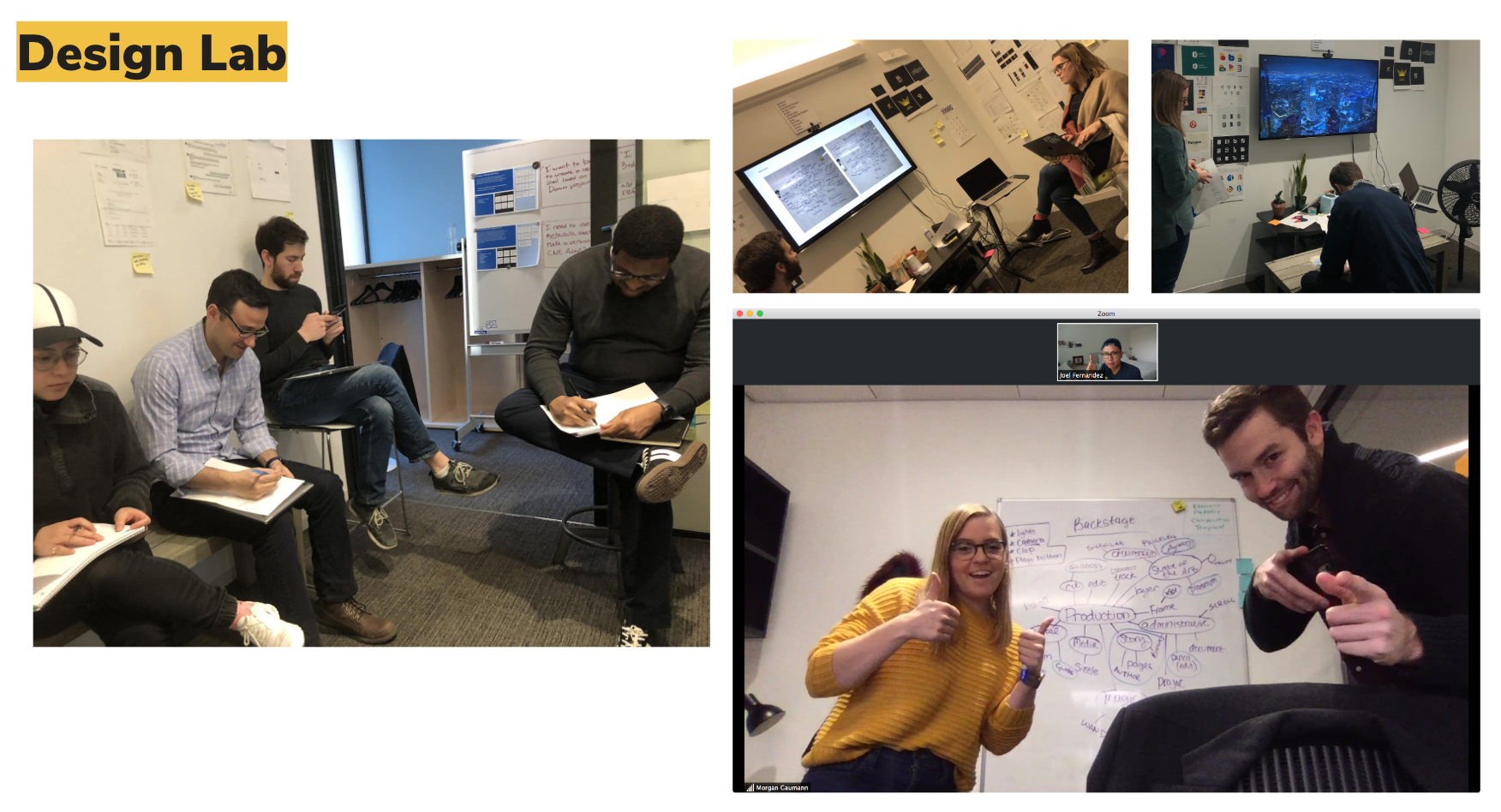
Design Lab sessions: embedded research with CNE production staff across Programming, Scheduling, and Business Affairs.
The quotes that came out of these sessions weren't edge cases — they were the norm. Every person I interviewed described a workflow built on workarounds: recreating fields across systems, chasing updates through email, and making scheduling decisions without visibility into upstream or downstream work.
"I find it annoying when I have to recreate fields from one system to another." — Programming & Strategy
"Sometimes data collected upstream is less thorough than data required for delivery." — Scheduling
"Communication about a project sometimes happens informally." — Business Affairs
Three core problem areas emerged from the research: production data spread across 4+ tools with no single source of truth, teams with no visibility into upstream or downstream work, and critical information like talent agreements and publish dates being entered manually in multiple places — creating costly risk.
Three personas, four core workflows, one clear architecture.
The research produced three primary personas representing distinct workflow modes: the Data Enterer managing high-volume metadata input across brands, the Scheduler coordinating production timelines and resource allocation, and the Rights Manager in Business Affairs tracking third-party agreements and clearances.
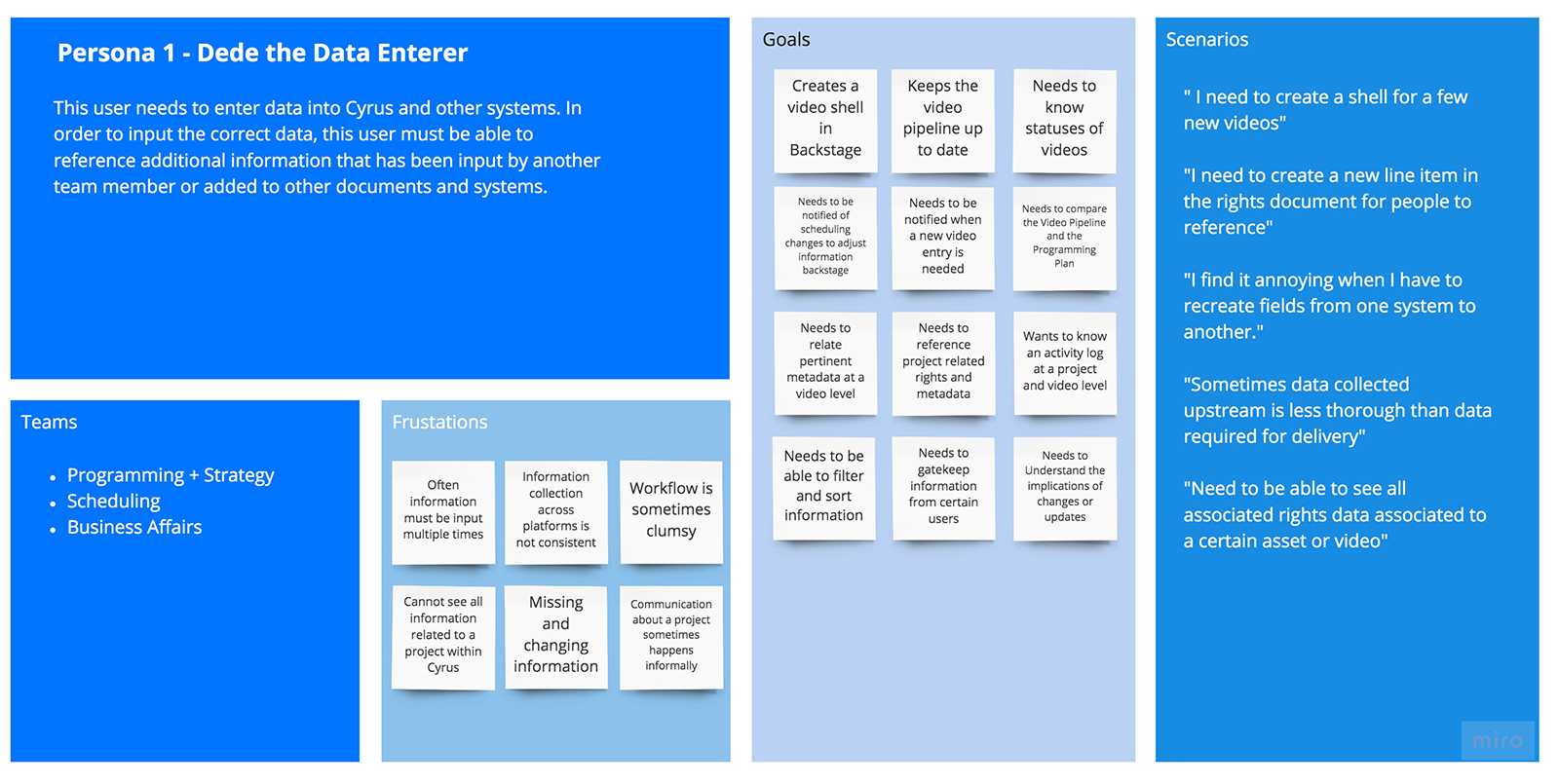
Persona: Dede the Data Enterer: representing the Programming, Scheduling, and Business Affairs teams who enter, reference, and maintain production data across the lifecycle.
From these personas, I mapped end-to-end user flows across four core workflows: project creation, production scheduling, agreement management, and post-production handoff. The flows revealed a clear information architecture with three primary modules (Projects, Agreements, and Scheduling) that became the backbone of the platform.
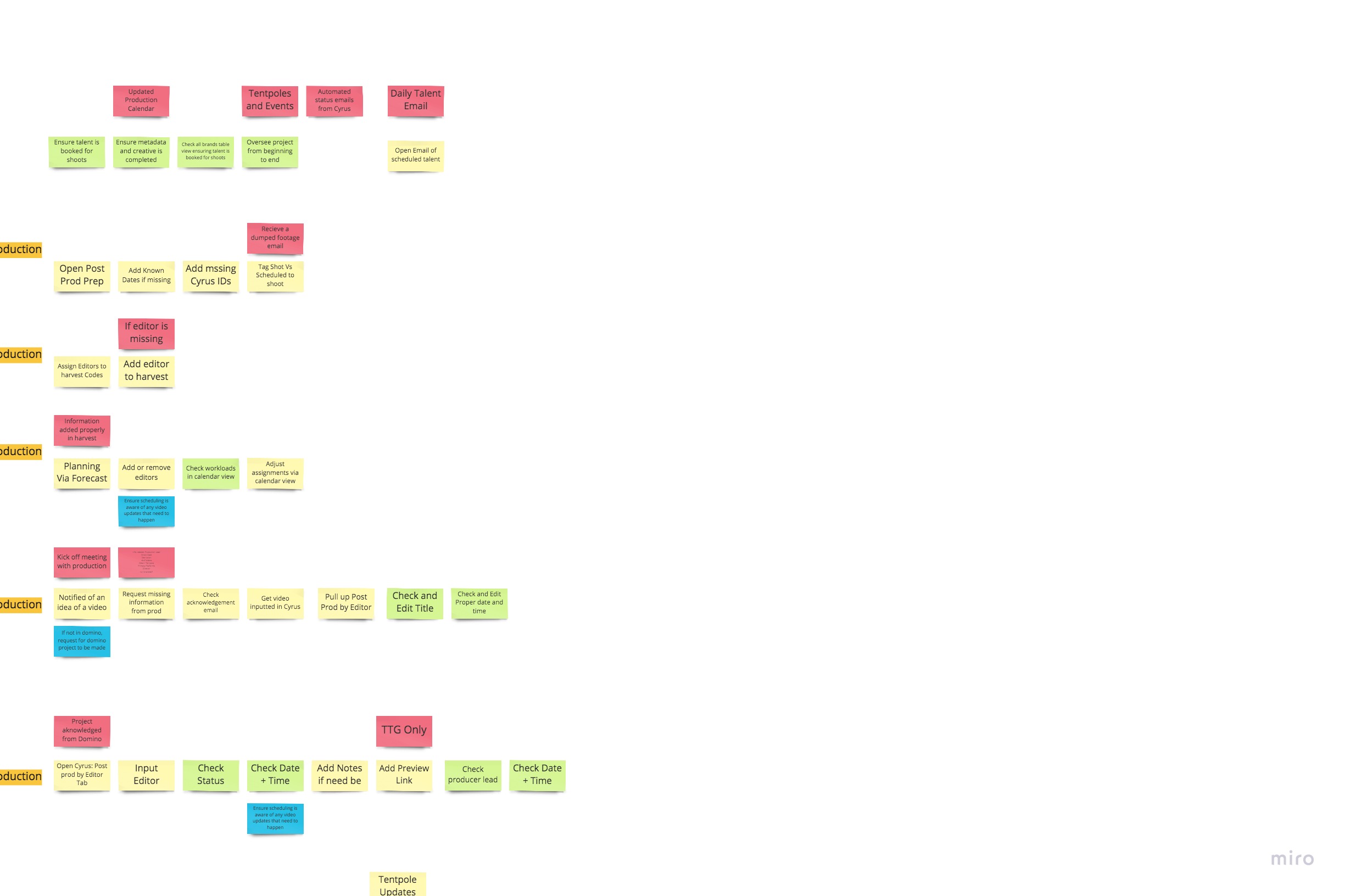
User flow mapping across pre-production, production, and post-production stages: conducted in Miro with cross-functional team collaboration.
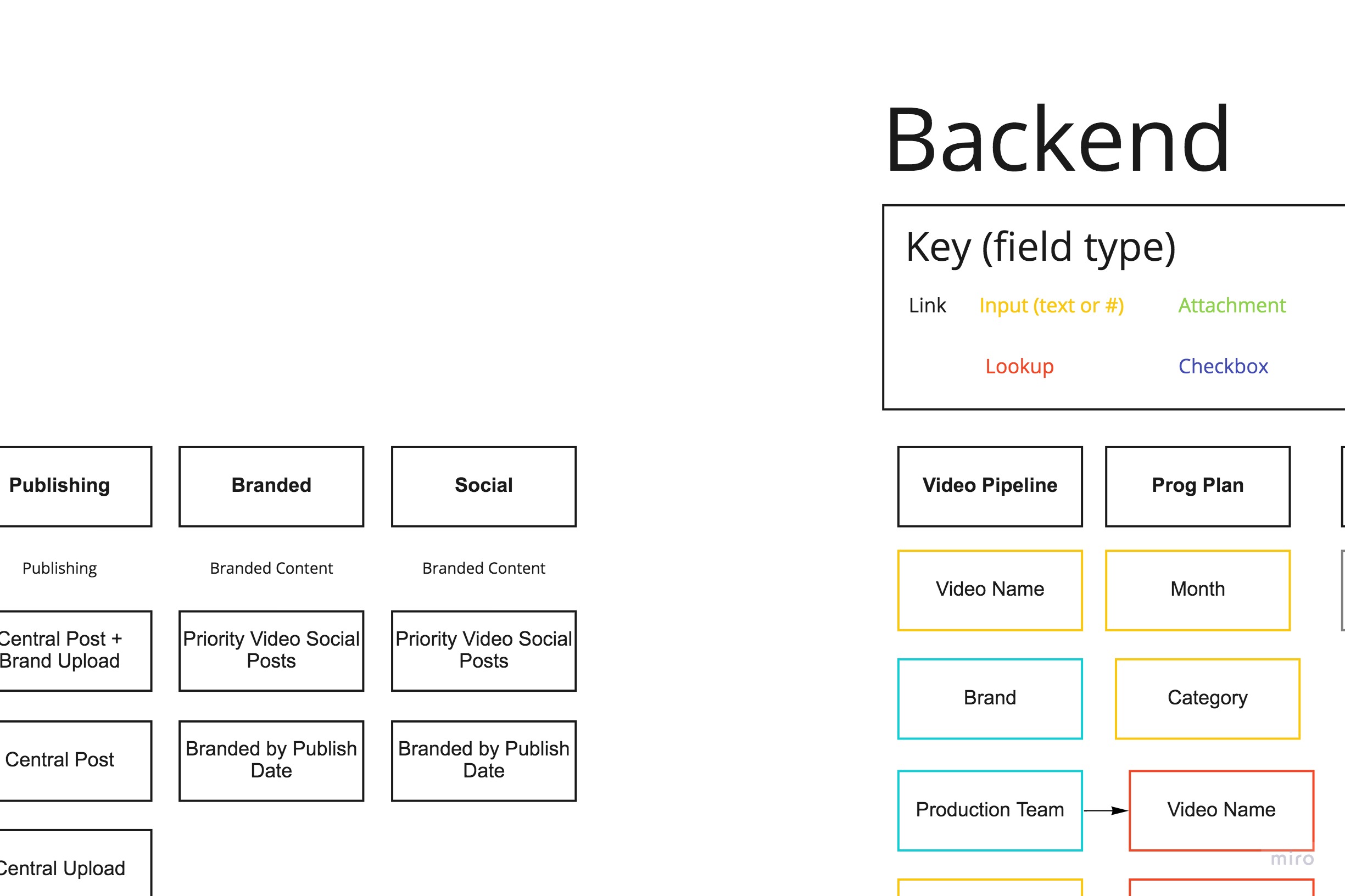
Information architecture and backend data model: mapping relationships between Video Pipeline, Programming Plan, and agreement types across brand workflows.
From rough sketches to a tested, production-ready platform.
Lo-Fidelity Exploration
Early sketches focused on the core tension in the product: Backstage needed to feel familiar enough for non-technical production staff to adopt quickly, while being powerful enough to replace multiple tools. I explored tabular views, card-based layouts, and calendar-first navigation before landing on a hybrid approach that served different user types without splitting the product.
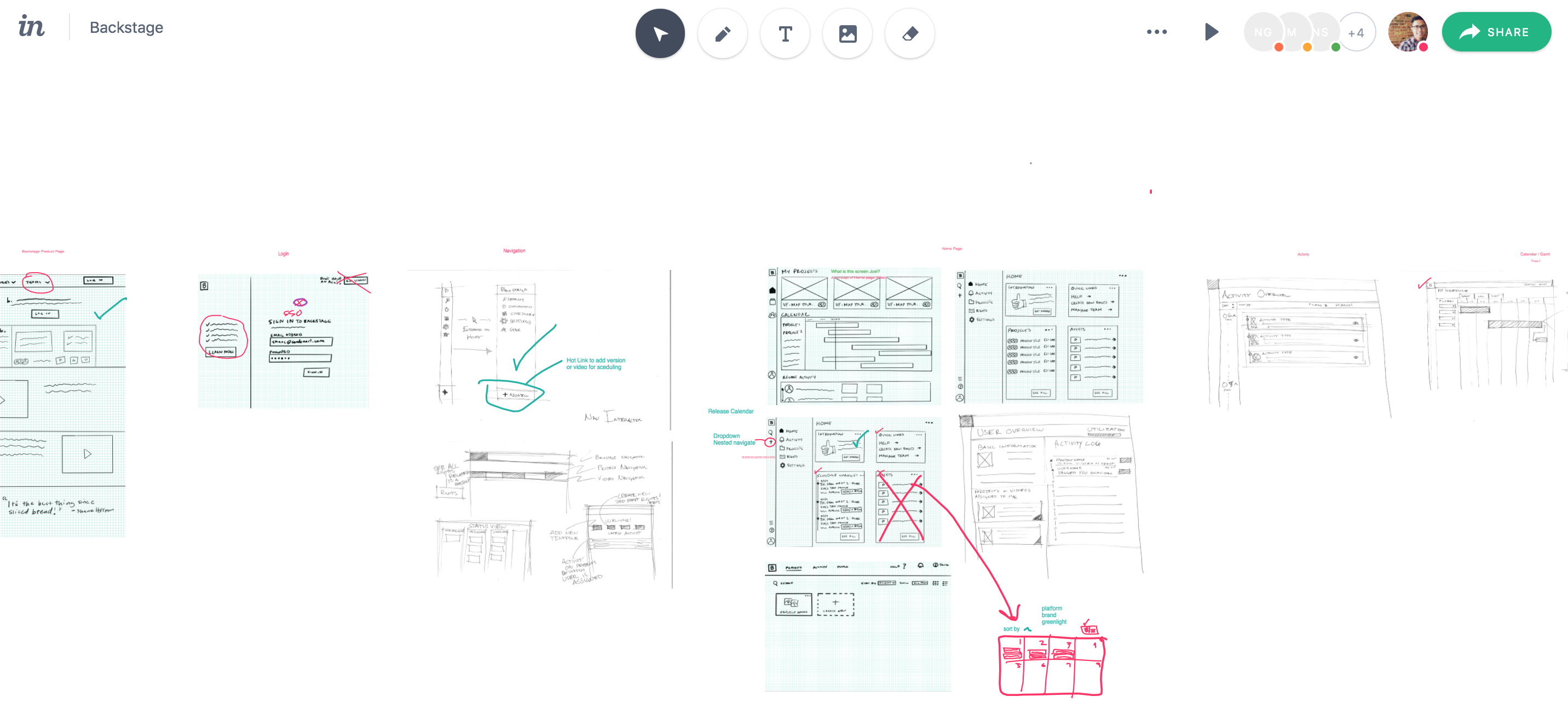
InVision board showing lo-fidelity wireframe progression: multiple layout approaches explored before user testing determined the optimal structure.
Usability Testing
I conducted three rounds of moderated usability testing with a representative mix of users from each persona group. Sessions were conducted both in-person and remotely, and surfaced critical interaction issues with the initial navigation model and data entry flows. Key findings led to a significant restructuring of the top navigation, moving from a feature-based structure to a workflow-based structure that mirrored how users actually moved through their day.
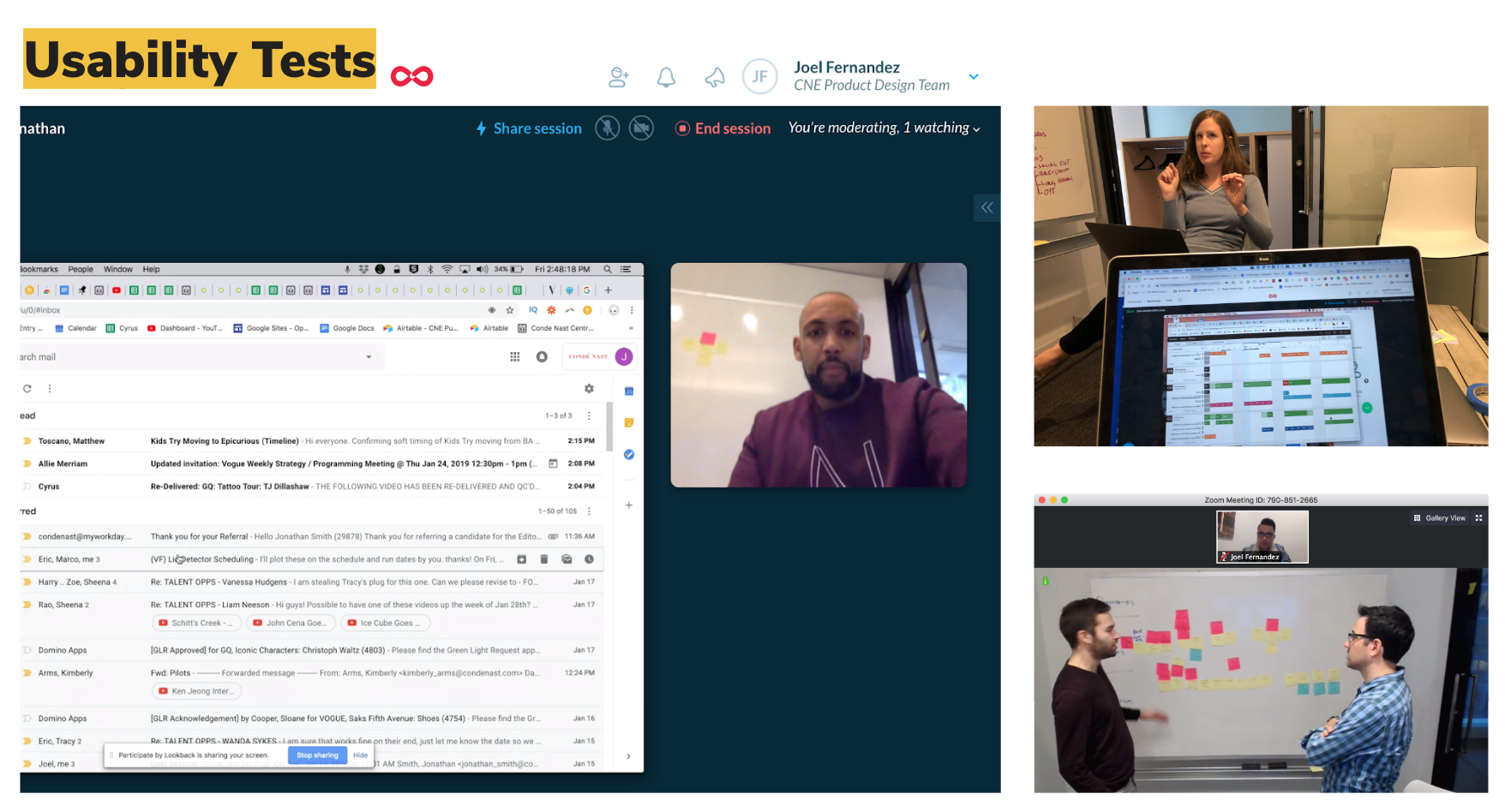
Remote and in-person usability testing sessions with CNE production staff: three rounds conducted across design iterations.
Home: Personalized Activity Feed
The home screen centers on a live activity feed showing real-time updates across all projects, giving each user immediate visibility into what's changed since they last logged in. A personalized "Last Viewed" panel reduces friction for users working across multiple brands simultaneously, and a weekly publishing calendar puts scheduling context front and center.
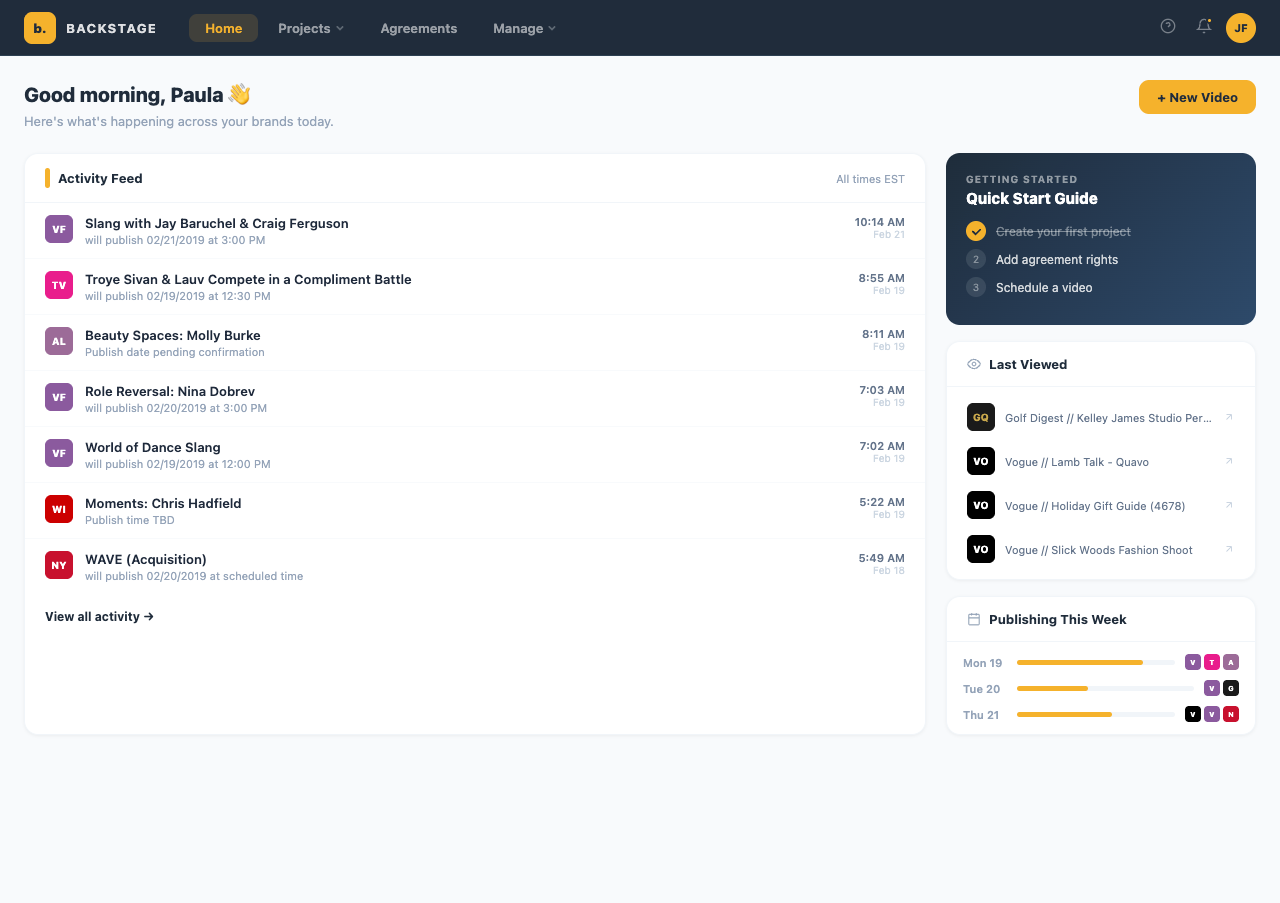
Backstage home: real-time activity feed with brand-coded updates, personalized "Last Viewed" panel, and publishing calendar quick-view.
Projects: Cross-Brand Video Library
The Projects module provides a searchable, filterable grid view of all active productions across all CNE brands. Users can toggle between card and list view, and filter by brand, status, or production type. Each card surfaces the most critical metadata: brand identity, project ID, and status, for fast scanning across a high-volume production slate.
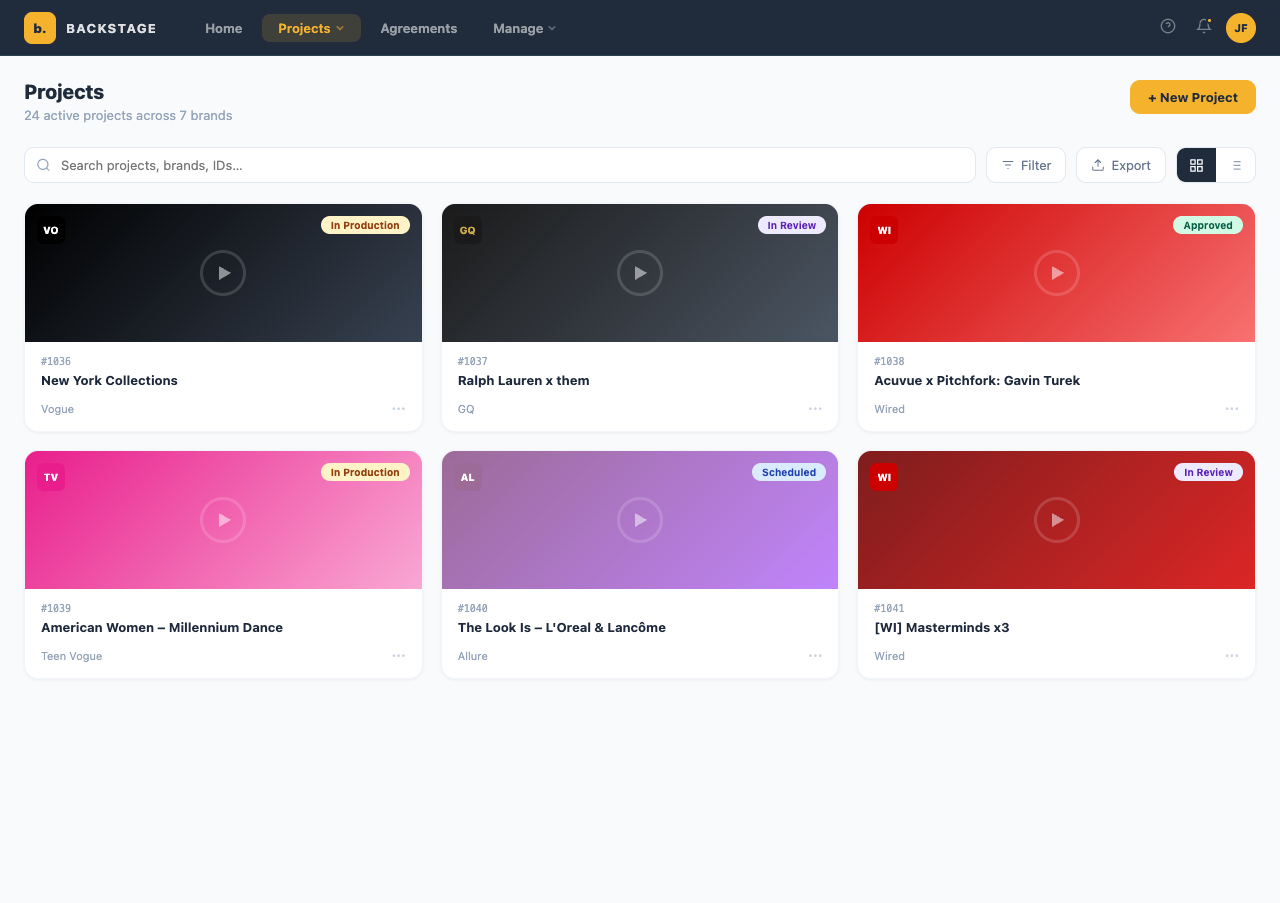
Projects grid: 24 active productions across 7 brands with brand-colored thumbnails, status badges, and filterable views across Vogue, GQ, Wired, and more.
Agreements: Rights and Clearance Management
The Agreements module replaced a fragmented system of email chains and spreadsheets used by Business Affairs to manage third-party rights clearances. Status tracking (Approved, Requested, Complete, Denied) is color-coded for instant visibility, and filtering by brand, agreement type, and recency lets teams quickly surface items requiring action without digging through inboxes.
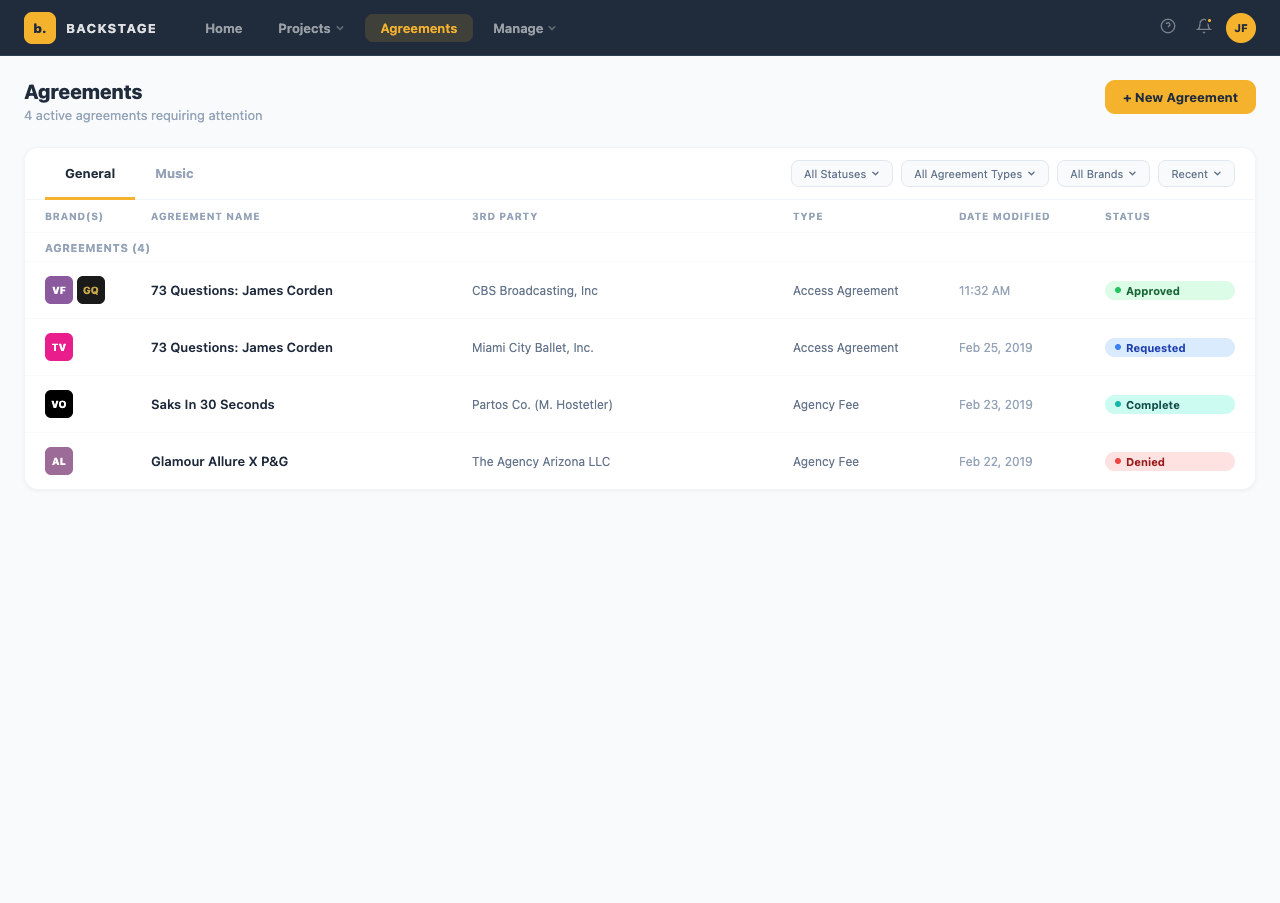
Agreements table: rights and clearance management with color-coded status tracking, third-party info, and agreement type classification across brands.
Within three months of launch, users stopped requesting access to the old systems.
Key Results
4+
Legacy systems replaced by a single platform
200+
CNE staff onboarded at launch across all major brands
↓60%
Reduction in scheduling conflicts within the first quarter
3
Departments unified — Programming, Scheduling, and Business Affairs — in one shared workflow
Backstage launched across all major CNE brands and was adopted as the primary production management platform for Vogue, GQ, Vanity Fair, Wired, The New Yorker, and more. To support ongoing feature releases and user adoption, I designed and maintained a Backstage Newsletter, a recurring internal communication keeping the production community informed as the product evolved.
The most meaningful signal of success: within three months of launch, users stopped requesting access to the old systems. Backstage had become the default.
Instrument for behavior earlier, and pressure-test the data model sooner.
We did strong qualitative research upfront, but we didn't have analytics instrumentation in place at launch. That meant the first few months of live usage produced anecdotal signal rather than behavioral data. Getting event tracking in place from day one would have let us prioritize post-launch iterations with much more confidence.
The other thing I'd revisit is how early we locked in the data model. The information architecture we arrived at through research was solid, but the backend relationships between Projects, Agreements, and the scheduling layer turned out to be more complex than our initial flows captured. Pressure-testing that model with engineering earlier, before the design was detailed, would have saved us a meaningful amount of rework mid-build.